
Setting Up Chick Paper: Optimal Coverage Area and Feed Distribution (Day 3)
Ekstreme Team
Ekstreme Poultry Farm
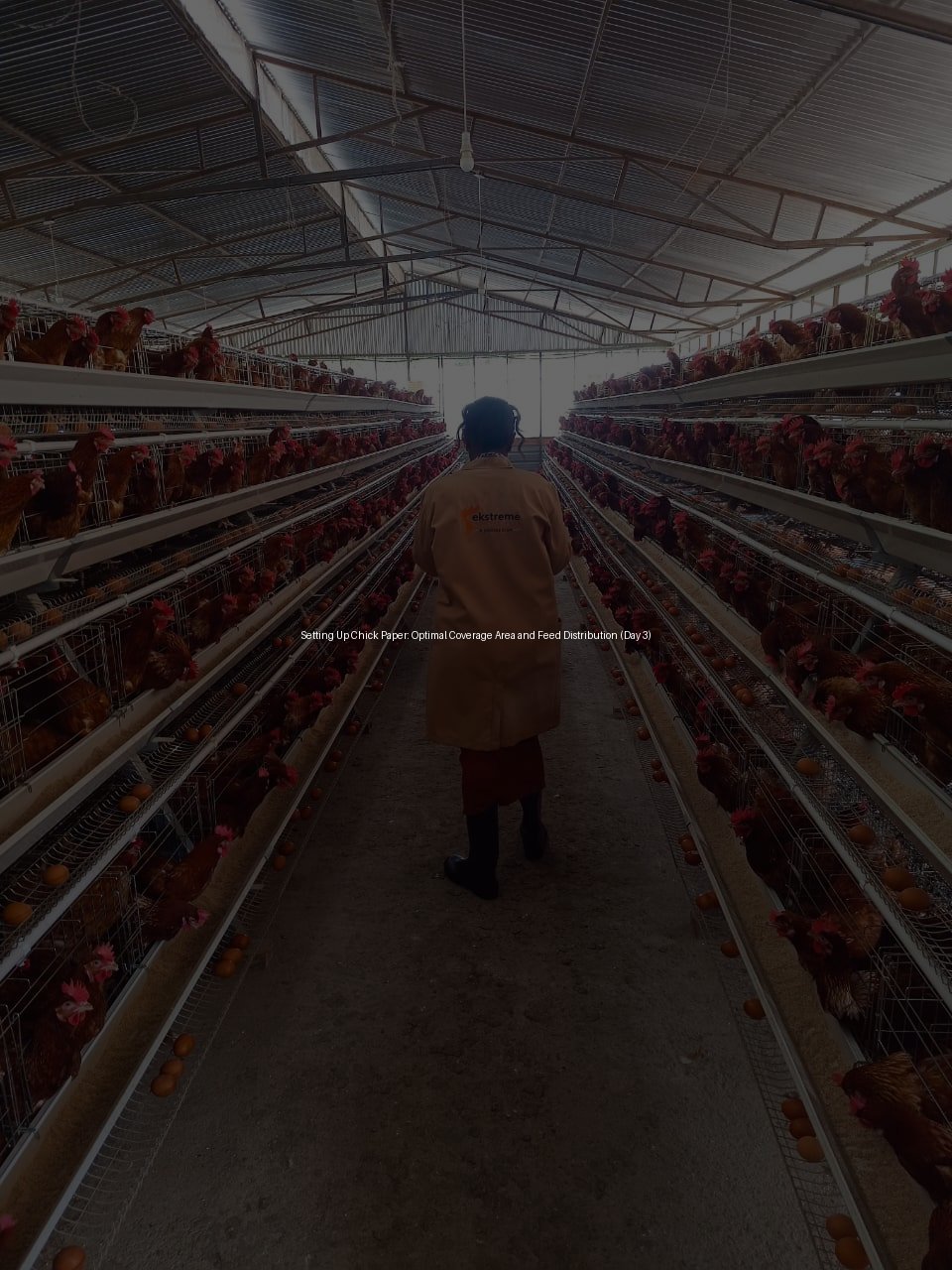
As Hy-Line Brown chicks reach their third day of life, a critical developmental window opens that significantly impacts long-term layer performance and skeletal integrity. This period is characterized by the emergence of innate foraging behaviors, where the birds begin to actively scratch and peck at the floor surface to simulate natural searching instincts. Industry best practices dictate that this behavioral shift must be supported by a controlled environment that balances thermal stability with appropriate floor texture to prevent developmental issues such as obesity or leg joint problems.
The primary objective for Day 3 feeding management is to transition from sole reliance on feeders to a mixed system that incorporates paper feeding. The standard target is to ensure that at least fifty percent of the total brooding area is covered with crumpled paper. This coverage is not optional but a mandatory component of precision poultry management, as it provides the necessary visual and tactile stimulation for chicks to engage with their feed. Operators must verify that the paper is distributed in a way that it remains accessible and does not clump, ensuring uniform access for the entire flock.
Quantitative feed distribution is the second half of this protocol. For each Hy-Line Brown chick present in the brooding unit, a specific amount of starter crumble must be hand-dispersed onto the paper. The recommended range is between fifty and seventy grams of feed per chick. This precise calibration ensures that the birds can easily locate and consume the feed pixels without the need for competitive dominance, thereby reducing stress and establishing positive associations with feeding locations.
Proper spatial arrangement is crucial for maximizing the efficacy of paper feeding. The paper should be spread in large, overlapping sheets rather than small, isolated piles. This configuration mimics a natural foraging ground and encourages lateral movement across the brooder footprint. Operators should avoid placing paper directly underneath heat sources without adequate insulation, as this can lead to excessive drying of the litter beneath and potential thermal stress on the chicks that spend extended periods on the paper.
The positioning of water drinkers relative to the paper feeding zones requires careful technical planning. Drinker lines should be aligned to create a corridor-like effect where water sources are positioned just outside the primary paper coverage area. This setup forces the chicks to walk between the water and the feed, increasing their physical activity levels. Hy-Line Brown chicks are particularly responsive to this movement, which aids in muscle development during the fragile first week of life.
A visual farm layout guide must be implemented to standardize this process across all production units. The floor plan should be marked with grid lines that indicate the fifty percent coverage boundary. For a standard ten-square-meter brooding area, this means covering at least five square meters with paper. Technical teams should use these markings as a baseline for daily audits, ensuring that the coverage remains consistent even as the birds begin to move the paper around during scratching activities.
Practical implementation requires the use of specific feeding tools to achieve the fifty to seventy grams per chick metric. Manual scattering is less efficient and prone to uneven distribution compared to using calibrated hand trowels or automated scattering devices. Operators should be trained to use a sweeping motion to distribute the feed evenly across the paper surface. This technique prevents the formation of dense mounds that can compact the feed and make it difficult for young chicks with small beaks to pick up the crumbles effectively.
The relationship between feed particle size and paper feeding success is also significant. Hy-Line Brown chicks at three days of age have beaks that are still developing precision. The starter crumble must be of a uniform size to prevent sorting behavior, where the chicks select only the smaller particles and leave the larger ones behind. Uneven particle distribution can lead to nutritional gaps and uneven growth rates within the flock, which are difficult to correct in later stages of production.
Monitoring the interaction between the flock and the environment is essential for real-time adjustments. Technicians should observe the chicks for signs of reluctance to approach the paper or for aggressive competition at the feeders. If a significant percentage of the flock ignores the paper, it may indicate that the floor temperature is too low, causing the birds to cluster under heat lamps instead. In such cases, the heat settings should be adjusted before adding more feed to the paper to ensure the birds are comfortable enough to engage with the feeding area.
By rigorously adhering to the Day 3 protocol of fifty percent paper coverage and precise feed dispersal, professional agribusinesses can lay a solid foundation for high-performing Hy-Line Brown layers. This early investment in behavioral conditioning and nutritional consistency reduces the incidence of skeletal disorders and promotes uniform flock development. Consistent execution of this strategy across all units will result in improved feed conversion rates and better overall livability, ultimately enhancing the economic return on investment for the operation.
Written by The Ekstreme Team
At Ekstreme Poultry Farm, we are dedicated to sharing insights, updates, and educational content to empower poultry farmers across Kenya.
Learn more about us →