
Commercial Layer vs. Dual-Purpose Brooding: Temperature and Space Comparison (Day 8)
Ekstreme Team
Ekstreme Poultry Farm
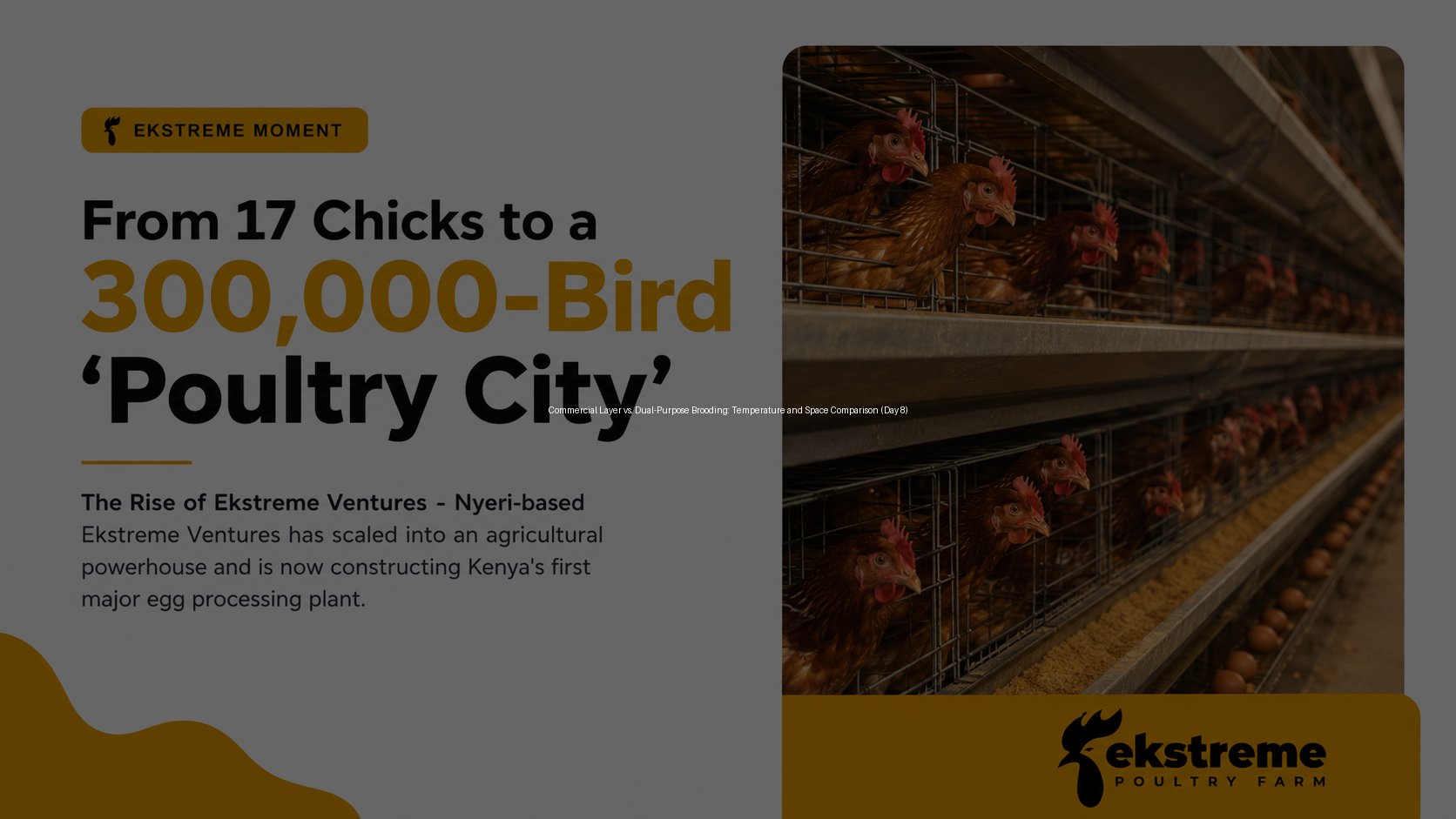
By the eighth day of life, commercial layer chicks and dual-purpose brooding stock diverge significantly in their physiological responses to environmental stress, necessitating distinct management protocols for optimal early growth. While both categories require precise thermal regulation, the specific breed lines within these groups exhibit unique tolerances that dictate the intensity of brooding systems. Understanding these differences is critical for agribusinesses aiming to minimize mortality rates and maximize feed efficiency during this vulnerable transition period from egg to mature bird.
For high-density commercial layer operations utilizing breeds such as Hy-Line, the environmental target on Day 8 remains strictly between 33 and 36 degrees Celsius. This narrower thermal window is essential because these birds are bred for maximum feed conversion and egg production rather than hardiness. The brooding area must maintain this temperature with high consistency, as fluctuations outside this range can trigger hyperthermia or hypothermia, leading to immediate drops in growth metrics and increased susceptibility to respiratory issues.
In contrast
dual-purpose breeds like Kenbro chicks demonstrate a broader adaptive capacity
thriving comfortably at a slightly lower baseline of approximately 32 degrees Celsius on the same developmental day. Their genetic predisposition for foraging and outdoor resilience allows them to tolerate minor temperature variances without the severe physiological stress seen in purely commercial layers. This characteristic enables producers to adopt semi-intensive space planning strategies that integrate early exposure to variable environmental conditions while maintaining safe brooding temperatures during the initial nights and stormy periods.
The comparative analysis of heat tolerance reveals that intensive commercial setups prioritize thermal uniformity through direct-fired or gas-heated brooders located in enclosed structures. These systems are engineered to eliminate micro-climatic shifts, ensuring that every square centimeter of the high-density floor operates within the 33-36 degree Celsius band. Any deviation in these controlled environments is penalized by the flock's inability to self-regulate effectively, resulting in higher early mortality factors associated with heat stress or chilling.
Semi-intensive setups, favored for dual-purpose breeds, leverage the birds' natural ability to move between warmer brooding zones and cooler, more spacious areas. This spatial flexibility allows for a semi-intensive outdoor space planning approach where the core brooding temperature is maintained at 32 degrees Celsius, but the overall environment provides greater air circulation and lower humidity levels. This setup reduces the incidence of ammonia accumulation and respiratory infections, which are common in the high-density, enclosed systems required for commercial layers.
From an economic and operational standpoint, the choice between these two brooding strategies directly impacts infrastructure investment and ongoing energy costs. Intensive layer operations require robust HVAC or independent heating systems capable of sustaining high heat loads in smaller, densely packed areas, whereas dual-purpose systems can utilize more passive solar heating or combined indoor-outdoor configurations. The latter reduces energy consumption but demands careful monitoring of external weather patterns to ensure the 32-degree Celsius threshold is not breached during environmental extremes.
Monitoring early mortality factors requires breed-specific vigilance; commercial layers show a sharp increase in mortality if ambient temperatures dip below 33 degrees Celsius for more than a few hours, while dual-purpose breeds typically only exhibit stress responses if temperatures fall significantly below 30 degrees Celsius or if space restriction becomes severe. Producers must implement weigh-down schedules and behavioral observation protocols that reflect these distinct thresholds, rather than applying a one-size-fits-all management template across different flock types.
Practical farmer takeaways suggest that aligning brooding infrastructure with the specific genetic potential of the stock is the most cost-effective strategy for long-term profitability. For commercial layer operations, the investment in precision temperature control systems is justified by the need to protect a high-value, low-tolerance genetic line. For dual-purpose flocks, the focus should shift toward optimizing space density and airflow, utilizing the birds' hardiness to create a robust, low-stress environment that supports both meat and egg production efficiency.
Ultimately, the distinction between commercial and dual-purpose brooding on Day 8 is not merely a matter of temperature dial settings but a fundamental difference in animal welfare and facility design philosophy. Success in modern agribusiness depends on recognizing that strict thermal density control serves the commercial model, while semi-intensive thermal stability supports the resilient dual-purpose model. Implementing the correct protocol ensures that the genetic investments in breeding are fully realized in the final performance metrics of the flock.
Written by The Ekstreme Team
At Ekstreme Poultry Farm, we are dedicated to sharing insights, updates, and educational content to empower poultry farmers across Kenya.
Learn more about us →