Commercial Layer vs. Dual-Purpose Brooding: Temperature and Space Comparison (Day 7)
Ekstreme Team
Ekstreme Poultry Farm
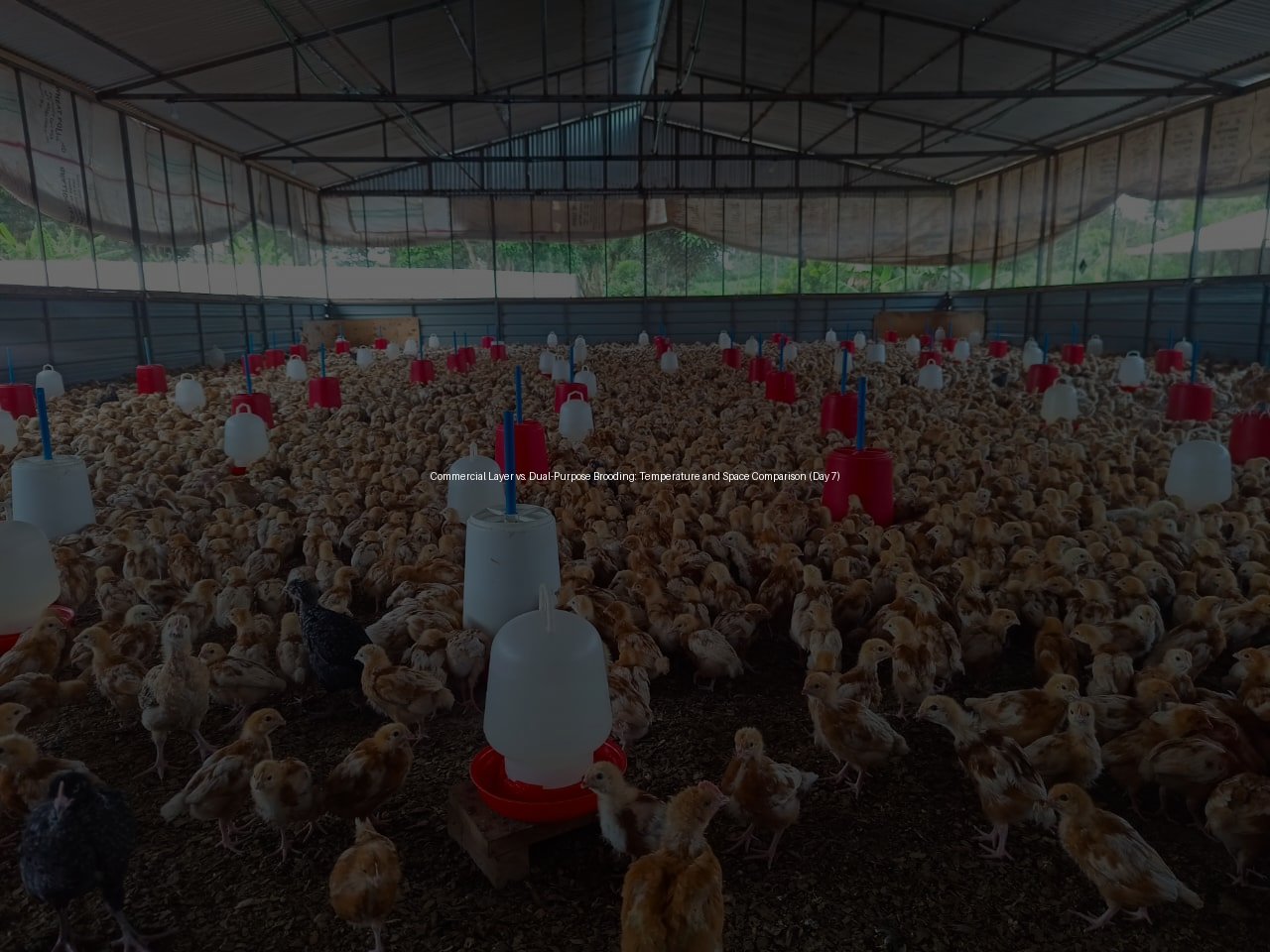
By the seventh day of life, the divergence in management protocols between high-performance commercial layers and dual-purpose breeds becomes a critical determinant for early chick survival. This period marks the end of the initial brooding phase, where physiological stability depends on precise environmental controls. For agribusinesses targeting maximum egg production, the operational differences between intensive indoor systems and semi-intensive outdoor planning require a rigorous comparison of temperature thresholds and spatial density metrics.
Hy-Line commercial layers exhibit a strict thermal sensitivity during this early stage, making the 33-36°C range an non-negotiable operational parameter. Deviations outside this window trigger immediate stress responses that can compromise immune development and feed intake efficiency. In high-density indoor barns, maintaining uniform heat across the entire floor area requires advanced brooder management to prevent cold spots that lead to huddling and subsequent necrosis.
In contrast, dual-purpose breeds such as the Kenbro demonstrate a broader thermal tolerance window, finding optimal growth conditions at a slightly lower average of 32°C. This breed adapts more effectively to the natural thermal fluctuations that occur in semi-intensive setups, where partial outdoor access allows for ventilation and temperature regulation without the need for constant artificial heating. Their physiological makeup allows them to manage heat dissipation more efficiently than their specialized commercial counterparts.
The comparison of heat tolerance reveals that intensive setups demand vigilant monitoring to prevent heat stress on commercial breeds, while semi-intensive systems leverage breed resilience to reduce energy costs. Commercial layers in high-density environments are more susceptible to respiratory issues if humidity and temperature are not perfectly balanced, whereas dual-purpose birds can utilize ambient air movement to self-regulate their core temperature more naturally.
Early mortality factors differ significantly between these two models, with high-density commercial brooding often leading to扎堆 behaviors and trampling if space is miscalculated. On day seven, the risk of cannibalism and pecking orders is highest in confined spaces, necessitating precise stocking rates. Conversely, the semi-intensive approach distributes environmental stressors over a larger footprint, reducing the immediate lethality of minor control failures inherent in closed systems.
Space planning on day seven reflects these thermal and behavioral differences, with commercial operations maximizing floor area efficiency to optimize total bird count per unit of infrastructure. Dual-purpose planning prioritizes access to outdoor ranges, which, while less efficient in square footage per head, supports the long-term welfare and reduced medication requirements of the flock. This difference in spatial strategy directly impacts the capital expenditure required for initial barn construction and brooding equipment.
For professional agribusinesses, the choice between these two models must be informed by the specific genetic potential of the stock and the available infrastructure. A high-density commercial setup requires a higher degree of automation and capital investment in climate control systems to meet the rigid 33-36°C requirement. Semi-intensive operations rely more on the breed's inherent hardiness and require less insulated housing, allowing for different cost structures in the early production cycle.
The practical takeaway for managers is that day seven serves as the critical validation point for the success of the chosen management model. Operators of commercial Hy-line flocks must ensure that every square meter of the brooding area maintains the target temperature, as variability is not an option. Managers of Kenbro flocks can afford a slightly wider tolerance range but must ensure adequate access to outdoor space to prevent density-related stress.
Ultimately, aligning the thermal environment with the specific breed characteristics prevents the compounding of early stressors that lead to long-term production losses. A thorough audit of temperature logs and chick behavior on the seventh day provides the data necessary to adjust feeders, drinkers, and space allocation for the subsequent weeks. This proactive management ensures that the genetic potential of both commercial and dual-purpose breeds is fully realized in the growing phase.
By integrating these technical metrics into the daily operational routine, agribusinesses can mitigate the risks associated with early chick mortality and optimize resource allocation. The distinct requirements of high-density intensive farming versus semi-intensive dual-purpose management are not interchangeable, and recognizing the specific needs of each breed at this early stage is fundamental to achieving sustainable and profitable poultry production.
Written by The Ekstreme Team
At Ekstreme Poultry Farm, we are dedicated to sharing insights, updates, and educational content to empower poultry farmers across Kenya.
Learn more about us →