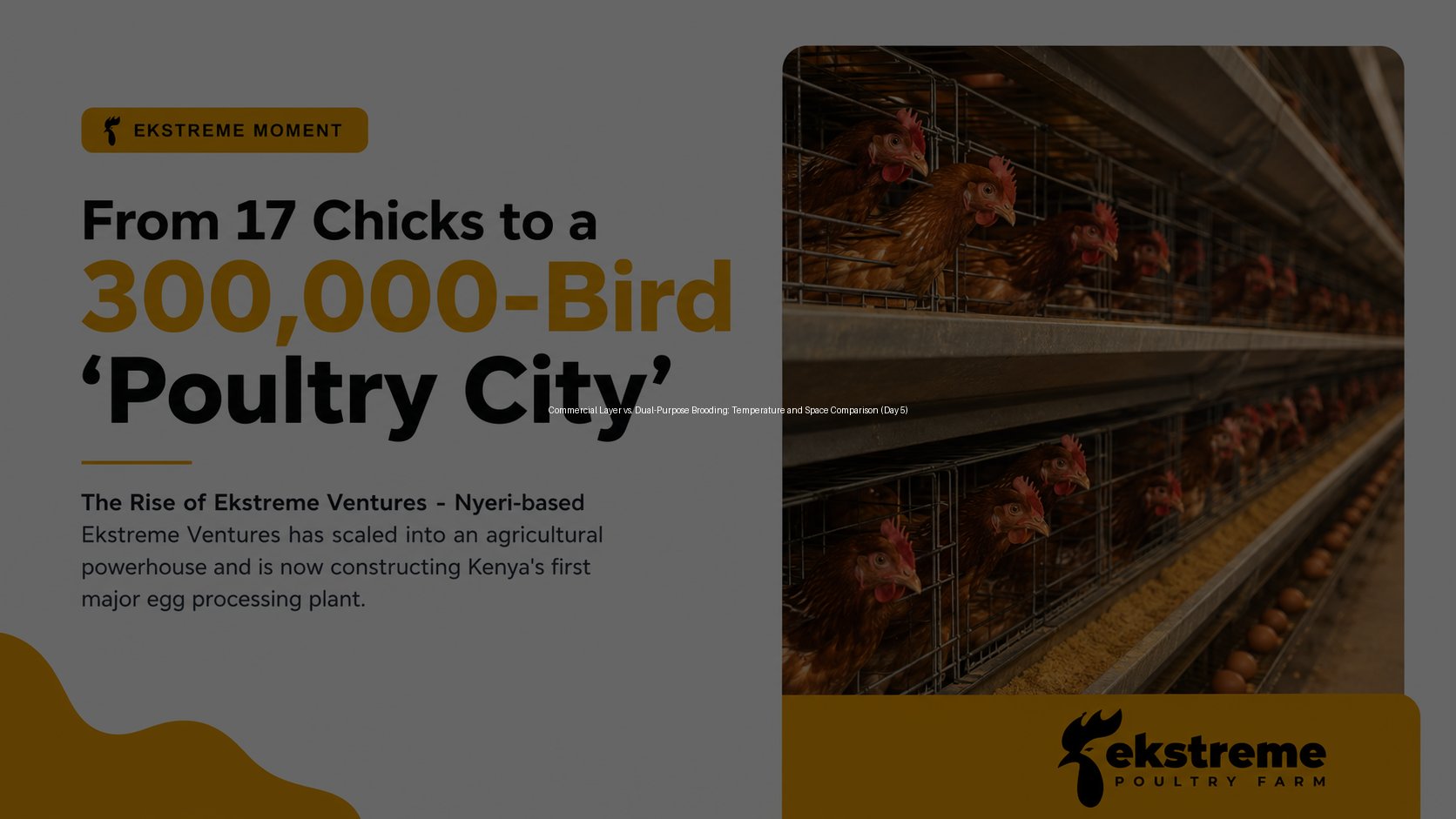
Commercial Layer vs. Dual-Purpose Brooding: Temperature and Space Comparison (Day 5)
Ekstreme Team
Ekstreme Poultry Farm
By the fifth day of hatching, commercial layer chicks and dual-purpose breeds such as the Kenbro exhibit distinct physiological adaptations that dictate their environmental requirements. Hy-Line layers, bred for maximum egg production in confined systems, have developed a narrow thermoneutral zone that demands precise thermal control to support rapid early growth. In contrast, Kenbro birds, selected for hardiness and foraging capability, display a broader tolerance range and a lower baseline metabolic heat generation. Understanding these divergent starting points is critical for agribusinesses managing mixed-flock operations or transitioning between management styles, as the first week sets the trajectory for long-term flock uniformity and feed conversion efficiency.
Temperature regulation on Day 5 serves as the primary determinant of survival and weight gain for both groups. For Hy-Line layers housed in intensive indoor environments, the target brooding temperature must be maintained strictly between 33 and 36 degrees Celsius. This narrow band ensures that the chicks can maintain body temperature without excessive caloric expenditure, allowing energy to be directed toward skeletal and muscular development. Deviations outside this range, even by a single degree, can trigger heat stress or cold shock, leading to immediate mortality spikes or the production of a chronically weak flock that will struggle to reach market weight.
Conversely, Kenbro chicks are optimally managed at a brooding temperature of approximately 32 degrees Celsius. This slightly lower set point reflects their more robust thermoregulatory capacity and their genetic predisposition for outdoor activity. Because these birds are often prepared for semi-intensive or free-range systems, their initial brooding phase is designed to simulate milder conditions rather than the heated enclosure environment typical of commercial layers. Maintaining this lower temperature helps prevent overheating while ensuring the chicks remain active and curious, behaviors that are essential for their developmental socialization and muscle engagement.
Space allocation on Day 5 presents a fundamental divergence in management philosophy between the two breeds. Commercial layer farms operate on high-density brooding principles, maximizing the use of limited floor area to achieve economies of scale. Hy-Line chicks are typically housed at densities of 25 to 35 birds per square meter during this initial phase. This high density is feasible because the controlled environment minimizes predator risk and simplifies the distribution of heat, feed, and water, allowing for uniform growth within a compact footprint.
Dual-purpose operations, particularly those targeting the Kenbro breed, adopt semi-intensive space planning that prioritizes lower stocking densities and access to varied terrain. On Day 5, these birds are often housed at densities of 10 to 15 birds per square meter, with immediate access to outdoor runs or mesh-strengthened enclosures. This spatial arrangement prevents the crowding stress that can inhibit immune function and promotes natural foraging behaviors. The expanded space allows for the development of stronger leg bones and deeper breast muscles, attributes that are less critical in the layer program but vital in the dual-purpose market.
A direct comparison of heat tolerance and early mortality factors reveals why intensive systems require tighter controls than semi-intensive ones. In high-density layer setups, rapid heat transfer between birds means that a mechanical failure in the heating system can cause a cascade of chilling effects across the entire brooding area within minutes. Early mortality in this context is predominantly driven by thermal shock and tracheal checks caused by temperature volatility. Conversely, in semi-intensive Kenbro setups, mortality drivers shift more toward predator exposure, environmental dampness, and behavioral competition, necessitating different biosecurity and infrastructure investments rather than solely thermal precision.
The implementation of automated environmental control systems is mandatory for the intensive Hy-Line model but optional or supplementary for the Kenbro model. Layer houses rely on infrared thermometers and integrated ventilation links to adjust heating elements and air exchange rates in real-time, keeping the 33 to 36-degree Celsius band stable regardless of external weather conditions. For Kenbro flocks, which may be exposed to fluctuating outdoor temperatures, management often relies on spot heating systems that provide a warm refuge while allowing the birds to move freely, thereby encouraging them to generate their own body heat and build resilience against colder nights.
Feed and water access frequency must be adjusted to match the density and metabolic demands of each group. In high-density layer brooding, feed lines are closely spaced to minimize competition and ensure that all chicks within the 35-bird-per-square-meter unit receive adequate nutrition during the critical early growth phase. For Kenbro birds in lower-density setups, scatter feeding is often employed to stimulate foraging instincts, which naturally increases their physical activity and dispersion across the available space. This difference in feeding strategy directly influences the uniformity of the flock, with intensive systems aiming for statistical uniformity and semi-intensive systems accepting a wider range of individual variation as a trade-off for hardiness.
From a professional agribusiness perspective, the choice between these two brooding models on Day 5 must align with long-term market positioning and infrastructure capabilities. Farms with significant capital investment in climate-controlled housing will find that the intensive Hy-Line model offers the highest predictability and lowest per-bird labor costs, provided that temperature precision is maintained. However, businesses seeking to access premium meat markets or eco-labeled egg products may find the semi-intensive Kenbro approach more profitable despite higher management attention, as the resulting bird exhibits superior conformation and consumer appeal.
The practical takeaway for farm managers is that Day 5 is the critical checkpoint where environmental strategy must be firmly established. For Hy-Line layers, this means verifying that all heating zones are calibrated to the 33 to 36-degree Celsius standard and that density remains high to support uniform growth. For Kenbro dual-purpose birds, the focus shifts to ensuring that the 32-degree Celsius base is maintained in sheltered areas while verifying that outdoor space is dry, secure, and sufficiently vast to support active foraging. Ignoring these breed-specific metrics in the first week often leads to irrecoverable losses in growth potential and flock viability later in the production cycle.
Written by The Ekstreme Team
At Ekstreme Poultry Farm, we are dedicated to sharing insights, updates, and educational content to empower poultry farmers across Kenya.
Learn more about us →