Managing Live Market Genetics: Why Kenbro Replaces Indigenous Village Breeds (Day 5)
Ekstreme Team
Ekstreme Poultry Farm
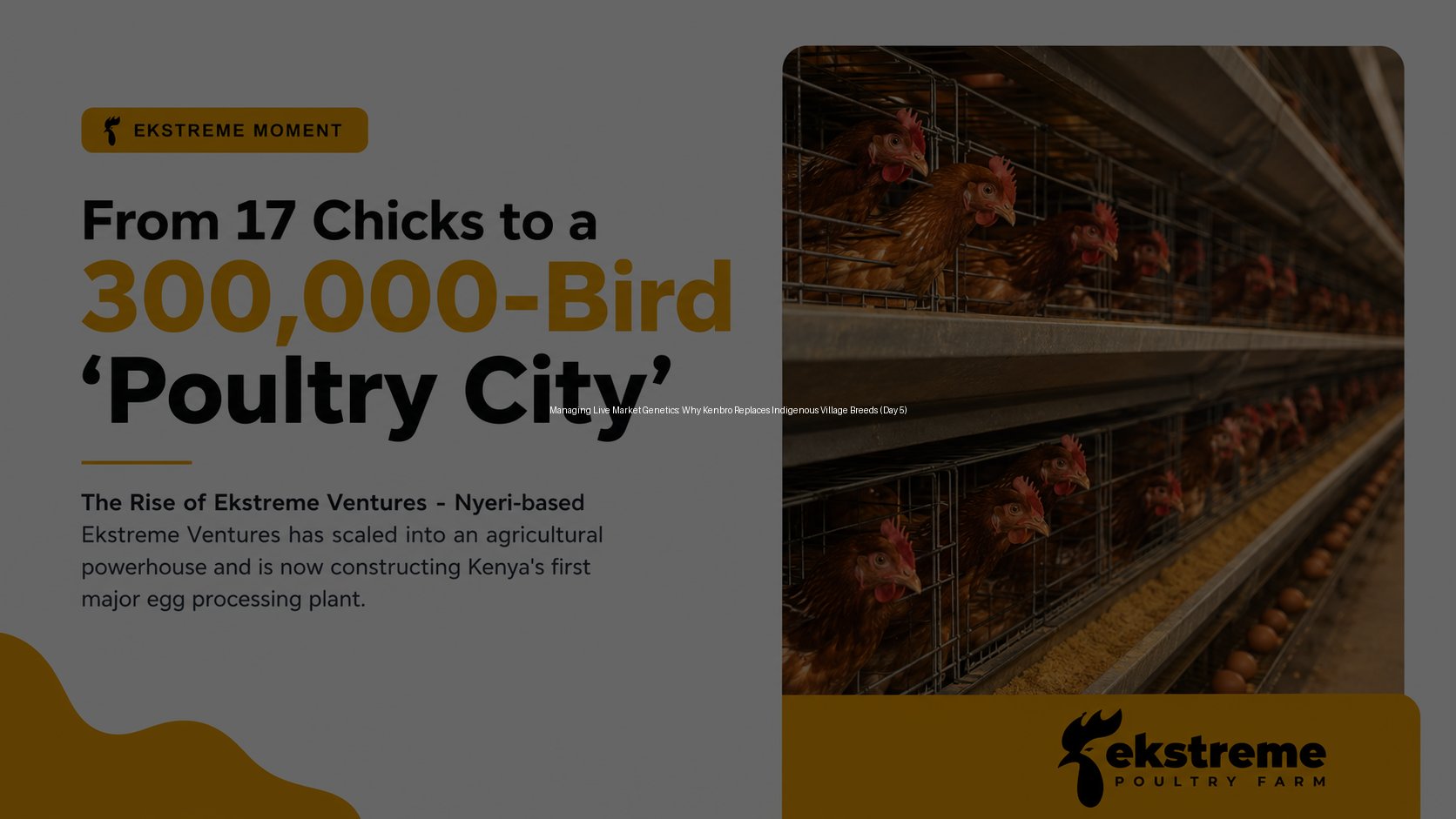
Managing a live poultry business requires a deep understanding of genetic performance, as the biological traits of your flock directly dictate your profit margins and market viability. For novice and mid-scale farmers looking to transition from traditional practices to a more profitable model, the focus must shift toward breeds that offer predictable growth rates and superior feed conversion. This article explores the specific economic advantages of the Kenbro breed, a specialized variant designed for the Kenyan and East African landscape, and explains why it is replacing indigenous village breeds in organized live markets.
Indigenous chickens, often referred to locally as kienyeji, have historically been valued for their hardiness, low maintenance requirements, and specific rustic flavor profiles that draw traditional buyers. However, these birds exhibit slow growth rates, typically requiring six to eight months to reach a marketable weight of just two to three kilograms. This prolonged cycle means that capital remains tied up in production for significantly longer periods, increasing feeding costs and delaying the return on investment for the farmer. Additionally, the genetic variability of local breeds results in inconsistent body weights, which makes bulk pricing and standardized market presentation difficult to achieve.
In contrast, the Kenbro breed is engineered to reach maturity for meat production within a tight ten to fourteen-week window. This accelerated growth cycle allows farmers to turn over their inventory approximately two to three times faster than with indigenous breeds. By reducing the production cycle, you decrease the total amount of feed consumed per bird and minimize the exposure to prolonged environmental risks such as disease outbreaks or seasonal feed shortages. This speed to market is the primary driver behind the improved cash flow that modern poultry operations rely on to sustain expansion.
Despite the rapid growth, the Kenbro breed retains the heavy carcass structure and the distinctive rustic flavor that indigenous breeds are known for. This hybrid approach addresses the critical gap in the live market where consumers seek the taste of traditional village chickens but are willing to pay for consistency and larger yields. The bird delivers a heavier killing weight, often exceeding four kilograms at maturity, which provides a higher volume of sellable meat per unit of genetic potential. This combination of speed and quality ensures that you are not compromising on the premium price point that live market buyers are willing to offer.
To visualize the economic impact, consider a side-by-side comparison of a one-hundred-bird batch. With indigenous chickens, you might spend fourteen weeks reaching market weight, incurring feed and labor costs that extend over a full season. When applying the same resources to a Kenbro batch, you achieve a comparable or superior market weight in under fourteen weeks, effectively resetting your production cycle before the initial batch has even finished. The cumulative effect of this turnover rate means that a Kenbro operation can generate the same annual revenue with a significantly smaller floor space and lower total feed expenditure.
The technical implementation of switching to Kenbor genetics involves careful biosecurity planning and nutritional management to support the rapid growth phase. Because these birds grow quickly, they require a consistent supply of high-quality starter and grower feeds that are more precise than the mixed forage and leftovers often given to village chickens. Farmers must ensure that their housing is ventilated and dry to prevent respiratory issues that can arise in fast-growing birds. Establishing these biological controls early ensures that the genetic potential of the Kenbro is fully realized without being hindered by health setbacks.
From a practical farming perspective, the main takeaway is that genetic selection is a financial strategy, not just a biological one. By choosing Kenbro, you are adopting a business model that prioritizes cash flow velocity and margin protection. You reduce the risk of market price fluctuations over a longer time horizon and gain the ability to reinvest profits into additional batches more frequently. This agility allows mid-scale farmers to scale operations steadily without requiring massive upfront capital for larger slow-growing herds, making the transition to improved genetics both accessible and highly rewarding.
Furthermore, the predictability of Kenbro genetics simplifies record-keeping and financial forecasting for your business. When growth curves are standardized across the flock, you can accurately project input costs and output weights for each batch. This level of data precision is essential for negotiating better prices with live market buyers, as you can demonstrate consistent quality and reliability. Over time, this reputation for consistency in weight and health status commands a premium in the live market, further enhancing the return on investment for dedicated breeders.
Implementing this change does not mean abandoning the cultural value of indigenous chickens entirely, but rather integrating improved genetics into a professional framework. Many successful farmers maintain a small number of local breeds for specialty niche markets while dedicating their main production lines to Kenbro for volume and efficiency. This diversified approach mitigates risk and allows you to cater to a broader customer base, from traditional cooks seeking flavor to commercial buyers seeking uniformity. The key is to align your genetic resources with your specific market demand and financial goals.
In conclusion, the economic case for replacing indigenous village breeds with Kenbro in live market operations is clear and compelling. The ten to fourteen-week maturity window, coupled with heavy carcass yield and retained rustic flavor, offers a superior balance of speed, quality, and cost efficiency. By adopting this genetic strategy, novice and mid-scale farmers can unlock higher profitability, reduce operational risks, and establish a sustainable poultry business that meets modern market standards while preserving the desirable taste profiles that consumers value.
Written by The Ekstreme Team
At Ekstreme Poultry Farm, we are dedicated to sharing insights, updates, and educational content to empower poultry farmers across Kenya.
Learn more about us →